Why the Note in Grandma's Drawer Beats Every Text Your Kid Will Ever Send
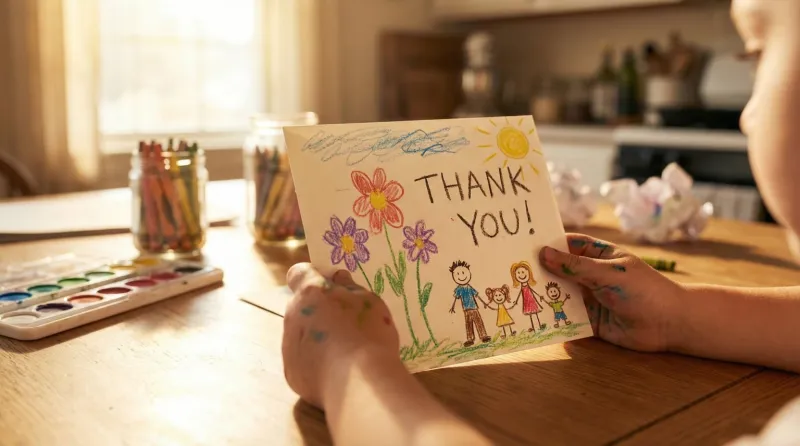
Photo: child handwriting thank you note crayon card kitchen table, via giftexperts.sirv.com
When my grandmother passed away two years ago, my mother and I spent an afternoon sorting through her dresser drawers. In the very back, tucked into a shoebox, we found a small stack of thank-you notes — every one of them written by me and my cousins, some as far back as thirty years ago. My handwriting at age seven, thanking her for a pair of mittens. My cousin's crooked crayon lettering, thanking her for a weekend visit.
She kept them. For decades. Long after the mittens wore out, long after we all grew up and moved away, those scraps of paper stayed in her drawer.
I don't think a single text message I've ever sent has been saved like that.
The Tradition We're Quietly Losing
Let's be honest about where we are: gratitude has gone digital, and mostly it looks like a quick "omg thank youuu 🙏" fired off in the group chat. It's not that kids (or adults) are ungrateful. It's that the ritual of sitting down to say thank you — with a pen, on paper, on purpose — has all but vanished.
And I'd argue we're poorer for it, and not in a nostalgic, things-were-better-before way. In a measurable, psychological way.
What Gratitude Actually Does to a Kid's Brain
Researchers who study gratitude in children have found some pretty compelling things. Kids who regularly practice gratitude — actually naming what they're thankful for and to whom — tend to show higher levels of happiness, better sleep, and stronger relationships with peers. Gratitude, in study after study, works less like a polite gesture and more like a mental habit that rewires how kids pay attention to the world.
But here's the part that matters most for the thank-you note debate: the benefit isn't just in feeling grateful. It's in articulating it. The act of writing forces a child to slow down and answer a deceptively hard question: What did this person do for me, and why did it matter?
A text says "thanks." A note says "I noticed you."
Making It Fun Instead of a Chore
The fastest way to make a kid hate thank-you notes is to hand them a stack of blank cards the day after their birthday party and bark orders. Trust me, I've seen it end in tears (sometimes mine). Instead, try meeting kids where they are:
Ages 3–5: The picture note. Nobody expects a toddler to write. Have them draw a picture of themselves playing with the gift, then dictate one sentence for you to write down. Their signature — even a scribble — goes at the bottom. Done.
Ages 6–9: The fill-in-the-blank. Keep a stack of simple cards pre-printed with prompts: "Dear ___, Thank you for ___. My favorite part was ___." Kids just fill in the blanks. It feels like a game, not homework.
Ages 10–13: The two-sentence rule. Pre-teens can handle a real note if you keep the bar low: one sentence about the gift, one sentence about the giver or a memory attached to them. "Thanks for the art set — I already started sketching the dog. It was so fun seeing you and hearing about your garden."
Teens: The upgrade. By high school, this becomes a genuinely useful life skill. Thank-you notes after job interviews, scholarship committees, and teachers who wrote recommendation letters. Frame it that way and you'll get less eye-rolling.
The Notes That Meant More Than the Gifts
Every family seems to have one of these stories if you ask around. A friend of mine told me about her son, then nine, who wrote a thank-you note to his grandfather that ended with "P.S. You're my favorite person to be bored with." Grandpa carried that note in his wallet for four years until it fell apart from handling.
Another mom shared that her daughter's note to an aunt — thanking her not for the toy, but for "always listening to my whole stories" — made the aunt cry at Thanksgiving. The gift, for the record, was a stuffed animal long since donated. The note is framed in the aunt's hallway.
That's the secret hiding inside this dusty old tradition: a thank-you note is rarely about the gift. Kids figure that out the first time they write one that comes from somewhere real. The note is a small act of seeing another person — and being seen back, sometimes years later, in a shoebox in a dresser drawer.
Start Small, Start Now
You don't need a stationery subscription or a calligraphy lesson. A pack of index cards and a marker will do. Pick one upcoming occasion — a birthday, a visit to grandma's, a coach's last game of the season — and have your kid send one note. Just one.
Because somewhere out there is a grandmother with a drawer, and your kid's crooked handwriting belongs in it.